
Before you write a single caption or design a graphic, the real work begins. Far too many creators jump straight into making content, throwing things at the wall to see what sticks. This "post and pray" approach is a recipe for burnout because it skips the most critical part: the strategy.
The difference between a post that gets a few pity likes and one that sparks a genuine conversation comes down to purpose.
Laying the Groundwork for Unforgettable Content

Engaging content isn't about chasing viral trends; it’s about making a real connection with your audience. But you can't connect with someone you don't know. That’s why the first two steps are non-negotiable: deeply understanding your specific audience and setting clear, measurable goals. This foundation ensures every post has a job to do.
Define Your Audience Beyond Demographics
Going past basic demographics like age and location is where the magic happens. You need to build out an audience persona so detailed it feels like you're describing a real person. What are their biggest headaches? What content do they binge on a Tuesday night? What online communities do they live in?
For instance, a fitness coach targeting busy professionals isn't just talking to people "aged 30-45." They're talking to someone who is time-crunched, probably stressed, and desperate for efficient, practical solutions. Their pain point isn't just "losing weight"—it's finding the energy to keep up with a demanding career and family life.
The goal is to move from a generic buyer profile to a human-centric persona. When you understand someone's daily struggles and aspirations, you can create content that feels like you're speaking directly to them.
Set Clear and Measurable Goals
Every single piece of content should have a job. Without a clear objective, you have no way to measure what’s working or how to improve your strategy over time. Your goals will directly shape the kind of content you create.
Here are a few common goals and how they translate into content:
- Increase Brand Awareness: The focus here is on shareability. Think infographics, relatable memes using the MakerSilo meme maker, or inspiring quotes that introduce your brand to new feeds.
- Generate Leads: This content needs to capture information. You’d create posts promoting a free webinar, a downloadable guide, or an exclusive newsletter—all of which require an email signup.
- Build Community: This goal is all about interaction. You'll want to post content that encourages comments, like asking direct questions, running polls, or sharing user-generated content to make people feel like they’re part of something.
The Anatomy of a High-Performing Social Post

Ever wonder what separates a post that gets completely ignored from one that blows up and sparks a real conversation? It almost always comes down to its structure.
The best social content follows a simple but incredibly powerful formula: Hook, Value, and Call-to-Action (CTA). Once you get this framework down, you give every piece of content a fighting chance in a ridiculously crowded feed.
Crafting an Unforgettable Hook
Every single great post starts with a killer hook. You have maybe three seconds to stop someone from scrolling, so your opening has to be sharp and intriguing. A weak hook means all the brilliant stuff that follows will never even get seen.
This is where you need to be bold. Ask a question that makes people rethink a common belief. Or lead with a surprising number that forces a pause.
A simple way to make your hook stand out is by adding a little visual flair. For example, dropping your first line into MakerSilo’s Glitch Text generator instantly breaks the boring, uniform pattern of a feed. It’s a tiny detail, but it can be the difference between a scroll and a stop.
Here are a few hook formulas that just plain work:
- The Provocative Question: "Are you still making this common marketing mistake?"
- The Surprising Stat: "Did you know 80% of social media ads fail to hold attention for more than 2.5 seconds?"
- The Bold Statement: "Your content strategy is probably working against you. Here’s why."
Once you’ve grabbed their attention, it’s time to deliver.
Delivering Genuine Value in the Body
This is the real meat of your post—the reason someone stopped scrolling in the first place. Value can be a practical tip, a compelling story, or a new piece of data. The trick is to be generous with what you know and make it easy to digest.
A huge mistake I see people make is trying to cram way too much into a single post. Just focus on one powerful idea and explain it clearly. Your goal is to make your audience feel smarter, inspired, or entertained.
If you’re explaining something complex, use bullet points or numbered lists to break it up. Carousels are perfect for this, letting you dedicate each slide to a single step or idea. You could easily turn one blog post into five key takeaways on five different slides. This format respects your audience's time and makes the info stick. Mastering this is a core part of learning how to create engaging social media content.
Mastering the Call to Action
Finally, every post needs a clear, direct Call to Action (CTA). You’ve hooked them in and given them something valuable. Now what? You have to tell them exactly what to do next. A good CTA makes the next step obvious and removes any friction.
Your CTA has to be specific. Instead of a lazy "learn more," try something that inspires action.
- Drive Conversation: "What’s the best business advice you’ve ever received? Drop it in the comments!"
- Encourage Saves: "Save this post for your next content planning session."
- Generate Leads: "Download our free content calendar template (link in bio) to get started."
By consistently using the Hook, Value, and CTA framework, you stop creating random posts and start building content that predictably grabs attention and gets results.
Choosing the Right Content Format for Maximum Impact
A brilliant idea in the wrong package will get completely ignored. The real secret to making content that people actually engage with is matching your message to the perfect format—for that specific platform, and for your audience's mindset right now.
What crushes it on LinkedIn might fall completely flat on Instagram. Getting these nuances right is the difference between a post that connects and one that just adds to the noise.
Aligning Format With Your Message
Your content's purpose should be the number one thing that dictates its format. Are you trying to break down a complex topic, or are you just sharing a quick, authentic moment from behind the scenes? Each goal needs a different vehicle.
For instance, a multi-step tutorial is a perfect candidate for an Instagram carousel. Each slide becomes a single, digestible step, making it super easy for your audience to follow along and save for later. On the other hand, a major brand announcement might land with more authority as a single, powerful static image.
Here are a few scenarios to help guide your thinking:
- To Educate or Explain: Use carousels or LinkedIn documents. These formats are fantastic for breaking down dense information into bite-sized, shareable pieces that don't feel overwhelming.
- To Entertain or Connect: Short-form video (Reels, TikToks) is your go-to. It’s perfect for showing off your brand's personality, jumping on trends, or sharing those quick, relatable moments that build community.
- To Announce or Inspire: A bold static image with a powerful caption can be a massive scroll-stopper. It delivers a strong, focused message with immediate impact.
The Surprising Data Behind Different Formats
It's easy to assume video is always the answer, but the data tells a much more interesting story. Short-form video is absolutely king for product discovery—a staggering 78% of consumers prefer it for learning about new offerings.
But here's the twist: on Instagram, static images actually pull in higher engagement, boasting a 6.2% rate compared to 3.5% for Reels, according to an analysis of over five million posts.
This doesn't mean you should ditch video. It means you need a mix. Use video to introduce and demonstrate, but use static images for direct engagement and those really important announcements.
Creating High-Quality Visuals Quickly
You don't need a full-time designer on staff to produce great-looking visuals. The key is to work smarter, not harder, by tapping into trends and formats that already resonate with your audience. Memes, for example, are a fantastic way to join a cultural conversation and show your brand doesn’t take itself too seriously.
Using a tool like MakerSilo's Meme Maker lets you jump on a popular format in seconds, creating something relevant and shareable without firing up Photoshop. Similarly, a custom wallpaper generator can help you produce branded backgrounds or quote graphics that keep your feed looking cohesive and professional.
By picking the right format and using smart tools, you make your content creation process both effective and a heck of a lot more efficient.
Give Your Visuals and Captions an Unfair Advantage
In a feed where visuals are everything, the look and feel of your content can instantly attract the right people or send them scrolling. A professional, cohesive aesthetic isn't about having a massive design budget; it's about being smart and consistent. This is your hands-on guide to making both your images and your words pop, even if you’re not a designer.
The goal is to create a visual signature. When someone sees one of your posts, they should instantly recognize it’s yours before they even check the username. That’s the power of a strong visual brand.
Nail Your Visual Identity
A strong visual identity is built on simple consistency. Start by choosing a core color palette—just three to five colors that really reflect your brand's personality. Then, pick two complementary fonts: one for headlines, one for body text.
This simple framework makes creating new content way faster and ensures your feed looks unified. For backgrounds, you can knock out stunning visuals that align with your brand colors using MakerSilo's gradient wallpaper generator, giving you a polished look in seconds.
Here are a few more tips to keep your visuals sharp:
- Use High-Quality Imagery: Always go for crisp, clear photos and graphics. Anything blurry or pixelated looks unprofessional and gets scrolled past.
- Embrace White Space: Don't clutter your designs. Leaving empty space around your text and key elements makes your message much easier to read and way more impactful.
- Create a Visual Hierarchy: Guide the viewer's eye. Make the most important element—like a headline or a product—the biggest or boldest thing in your design.
By focusing on these fundamentals, you’ll build a feed that not only looks great but also feels trustworthy and professional.
Write Captions That Actually Build Community
Your visual makes them stop; your caption makes them stay. A great caption does more than just describe the image—it starts a conversation, offers real value, and builds a genuine connection with your audience. Think of your captions as mini-stories or valuable micro-lessons.
The key is to write like you speak. Ditch the corporate jargon and use a conversational tone that feels authentic. Sometimes, injecting personality is as simple as adding the right symbol. MakerSilo’s Symbols library lets you copy everything from music notes (♫) to unique kaomoji (´。• ᵕ •。`) with one click, adding a human touch that plain text just can't match.
Your captions are a direct line to your community. Use them to ask questions, share vulnerabilities, and invite people into your world. Engagement isn't just a metric; it's a relationship.
You also need to think about the platform's engagement style. For instance, in 2025, LinkedIn boasts the highest average engagement rate of any major platform at 6.50%. This is driven by formats like documents, which see an incredible 37% engagement rate, proving that audiences on different platforms crave different types of value. You can find more social media engagement insights to discover how to tailor your content for each platform.
Ultimately, mastering how to create engaging social media content is about combining stunning visuals with compelling copy. Use tools to speed up your workflow, but always lead with authentic, valuable communication.
Building a Sustainable Content Creation Workflow
Consistency is the engine that drives social media growth, but that daily pressure to post can lead to serious burnout, fast. The answer isn't to just work harder. It's about building a smarter, more sustainable workflow that actually protects your time and energy.
Moving away from the daily content scramble is a total game-changer. This means you stop creating on the fly and start planning everything in dedicated, focused blocks of time.
Master the Art of Content Batching
Content batching is a simple but powerful idea: create all your social media content for a set period—like a week or even a month—all in one go. Instead of constantly switching between brainstorming, writing, and designing every single day, you knock out one task at a time. Trust me, it’s way more efficient.
Here’s what that could look like on a Monday morning:
- Hour 1 (Brainstorming): Map out all your post ideas for the week.
- Hour 2 (Writing): Write all the captions for those posts in a single doc.
- Hour 3 (Designing): Create all the visuals to go with them, from graphics to video clips.
This approach not only saves a ridiculous amount of time but also helps make your content feel more cohesive and strategic. Plus, it frees up the rest of your week to focus on what really moves the needle: engaging with your community in real-time.
Work Smarter with Content Repurposing
The most successful creators aren't constantly pulling new ideas out of thin air. They’ve mastered the art of repurposing. They take one bigger piece of content and slice it into a dozen smaller assets for social media. It's the best way to get maximum value from your best ideas.
A single, well-researched blog post or YouTube video can easily be chopped up into a full week of killer content.
Repurposing isn't about being lazy; it's about being strategic. You've already done the hard work of creating a valuable piece of content. Now, your job is to deliver that value in every format your audience consumes.
For instance, one video can become:
- Several short video clips for Reels and TikTok.
- A carousel post on Instagram breaking down key takeaways.
- Quote graphics for X and Facebook.
- An audio clip for a podcast or audiogram.
This process ensures your content calendar stays full without forcing you to be in "creation mode" 24/7. If you need a hand brainstorming that foundational piece of content, a tool like a YouTube channel idea generator can be a great place to find inspiration for a cornerstone video.
This infographic breaks down a simple visual creation process that plugs right into a batching workflow.
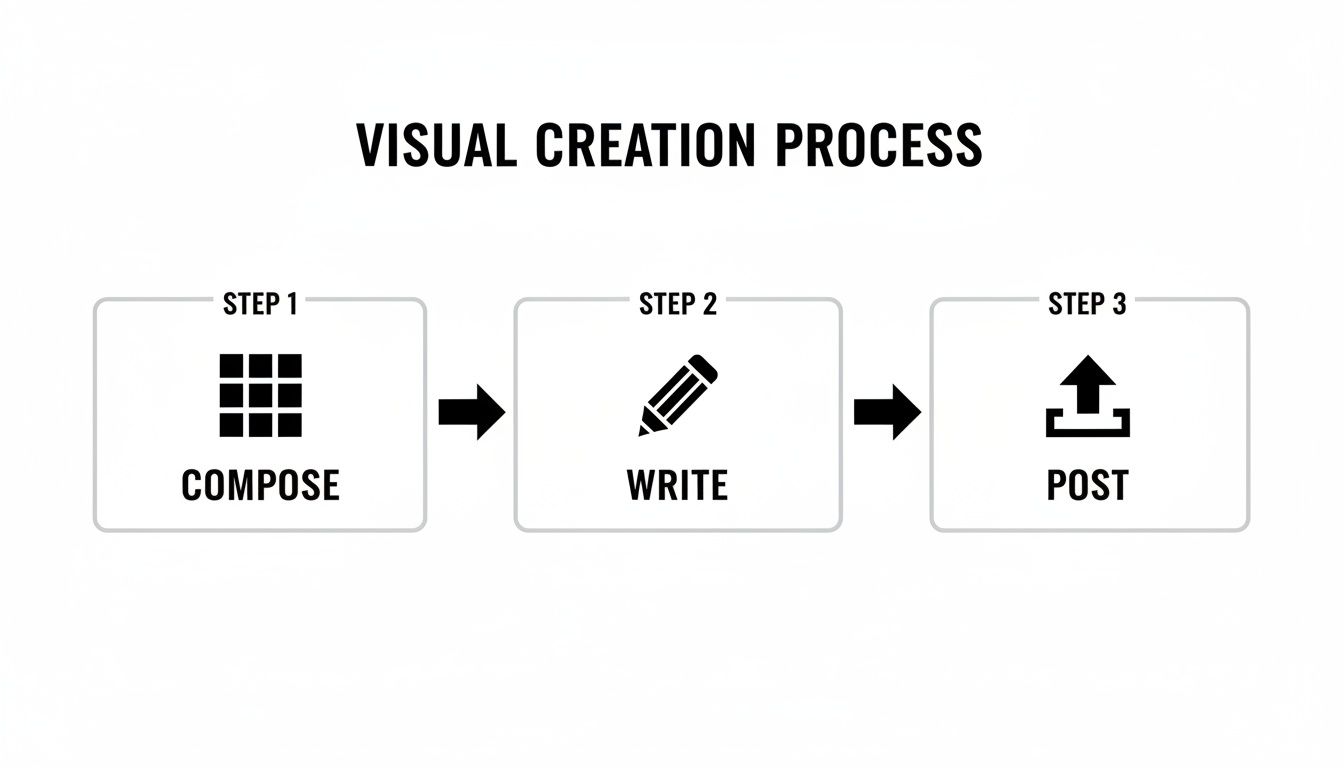
By keeping the creative stages separate—composing, writing, and posting—you build a streamlined system that cuts down on context switching and seriously boosts your productivity.
Measuring What Matters and Optimizing for Growth
Look, creating awesome content is only half the battle. If you really want to grow, you have to know what’s working, what’s flopping, and why. This is the moment you graduate from content creator to content strategist, letting the data guide your next move.
So many creators get hung up on vanity metrics. Things like likes and follower counts feel good, sure, but they don't paint the full picture. The real magic happens when you focus on the numbers that signal a genuine connection with your audience.
Focus on Metrics That Signal Real Engagement
To get a real sense of your impact, you need to track the metrics that show people are actually doing something with your content. These are the numbers that prove your work is hitting home.
Here's what I always keep a close eye on:
- Shares: This is the ultimate stamp of approval. When someone shares your post, they're basically telling their own network, "Hey, this is worth your time."
- Saves: A save is a huge tell. It means your content was so helpful or inspiring that someone wants to come back to it again and again. That's gold for educational or evergreen posts.
- Comments: I'm talking about real comments here, not just fire emojis. When your content sparks a conversation, you know you've struck a chord.
Zeroing in on these metrics helps you figure out which content is truly valuable, not just something people scroll past. This is the core of learning how to create engaging social media content that builds a real, loyal community.
A post with 10 saves and 5 thoughtful comments is almost always more valuable than one with 100 likes and crickets. One builds an audience; the other just collects a fleeting thumbs-up.
Using Data to Refine Your Strategy
Think of your analytics dashboard as a treasure map. Dive in regularly and look at your top posts, filtering specifically for the highest shares and saves. It won't take long before you start spotting patterns.
Maybe you'll notice your user-generated content (UGC) posts are blowing everything else out of the water. Honestly, this wouldn't be a surprise—UGC often drives 28% more engagement than standard branded posts and is seen as 2.4x more authentic, especially by younger crowds. You can dig into more insights about social media marketing to see just how powerful different content types can be.
Once you find a winning formula, run some simple A/B tests. Take the same core idea but try it with two different hooks or visuals. See which one lands better. This feedback loop turns content creation from a guessing game into a repeatable system for growth.
Got Questions About Content Creation? We've Got Answers.
Even the sharpest content plan runs into real-world questions. When you're in the thick of creating, it's easy to get stuck on the little details. Let's tackle some of the most common hurdles creators face so you can stay consistent and keep your momentum going.
How Often Should I Actually Post?
There’s no magic number here. The real secret is that consistency beats frequency every single time. It's way better to publish three incredible posts a week that people love than to churn out seven mediocre ones that fall flat.
As a starting point, aim for 3-5 high-quality posts per week on platforms like Instagram and Facebook.
Of course, the ideal cadence really boils down to your specific audience and where you're posting.
- On fast-paced platforms like X (formerly Twitter), you can get away with multiple posts a day without overwhelming anyone.
- For professional networks like LinkedIn, you'll likely see better results with 2-3 thoughtful posts a week.
The best move? Dive into your analytics. See when your audience is online and most active, then test different schedules. This is how you figure out the perfect timing to land your content for maximum impact.
I'm Stuck. Where Do I Find New Content Ideas?
Start by listening. Seriously. Your audience is handing you content ideas on a silver platter every single day. What are the questions they ask over and over in your DMs and comments? What's the one problem they're always trying to solve?
The best content ideas don't come from a vacuum; they come from genuine curiosity about your audience's world. Pay attention to their comments, DMs, and conversations in related communities.
You can also check out what your competitors are doing. Look at their top-performing posts to spot themes that are clearly hitting the mark in your niche. And don't forget to look at your own greatest hits! A popular blog post can be sliced into a carousel, a short video script, or a whole series of quick tips.
How Can I Get More People to Interact With My Posts?
Engagement is a two-way street. If you want more interaction, you have to actively ask for it.
Try ending your captions with a direct question or a clear call-to-action that makes it easy for someone to respond. Use interactive features like polls and quizzes in your Stories—they're low-effort for your followers and genuinely fun to participate in.
But here’s the most important part: when people take the time to comment, reply thoughtfully. Don't just drop a heart emoji. Acknowledging their input shows you're actually listening and helps build a real, buzzing community around your brand.
Ready to make your content stand out in seconds? MakerSilo gives you free tools to transform your text, create memes, and design unique visuals instantly. Elevate your posts at https://makersilo.com.
Powered by the Outrank tool